

Sustainability
ecological transition
Index
New technologies in the field of mining and impact on the ecological transition
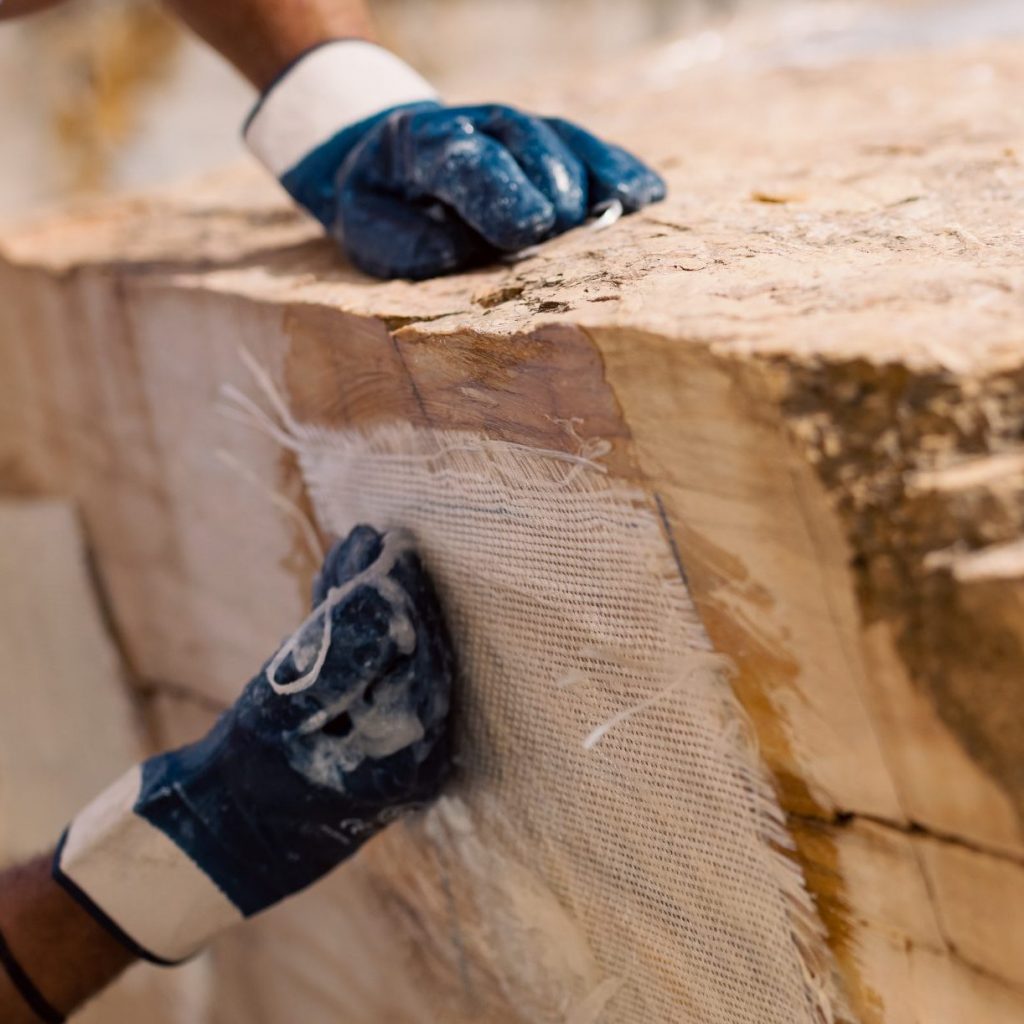
The most recent technologies for securing the bank and for restoring blocks are of great importance when there are problems with structural defects in the material.
These technologies make it possible to increase extraction efficiency and drastically reduce waste at the same time, with a consequent improvement in sustainability, product quality, and cost reduction.
We always encourage our customers to evaluate the preference granted to suppliers and the material selection criteria on a case-by-case basis, also in consideration of these aspects.
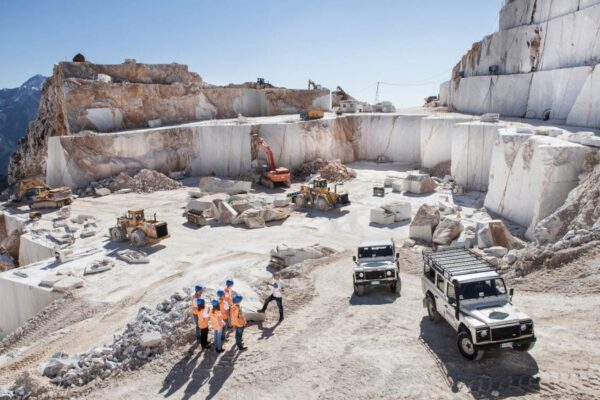
Traditional extraction method
Le tecnologie tradizionali, attualmente largamente impiegate nel settore estrattivo dei materiali lapidei, prevedono di isolare una porzione di roccia di grandi dimensioni, tipicamente:
 Height from 3 m to 8 m (average 6 m)
Length from 6 to 30 m (average 15 m)
Depth 2 m or 6 m (average 3 m)
The bank is sectioned from the mountain with cutting technologies that involve the use of diamond wire machines and chain machines.
Natural fractures can be used instead of …
[read more] cuts. The volume of rock thus prepared must be overturned by 90 degrees to bring the vertical wall to the ground. Overturning is obtained with the use of hydraulic cushions, hydraulic jacks, and help earthmoving equipment. An accumulation of earth and debris is prepared in the place where the bank falls to mitigate the impact as much as possible. [/read]
Waste management
The rock that makes up the bank is typically characterized by the presence of natural, latent or overt fractures, which in the vast majority of cases cause multiple failure of the bank, which fractures into many separate portions: the objective of the quarry is to produce as much as possible large blocks (ideally 3 m x 2 m x 2 m), squared and oriented as much as possible so as to maximize the aesthetic result of the two faces of the block itself which, after sawing, will become slabs (i.e. the starting semi-finished product for making any worked).
Compared to the extracted volume, the volume of blocks produced …[read more] in different sizes and with shapes that are not perfectly squared represents from 6% to 50% of the extracted volume, the typical percentage depends a lot on the nature of the material and on the original fracturing condition at that point of the mass primitive rock, but in most cases it is between 10% and 30%. By contrast, the remaining 90% up to 70% represents waste material, which must be removed and further reduced into gravel (crushed stone) or calcium carbonate powder for use in various industries (pharmaceutical, rubber, just to name a few). Naturally the economic result of the product of a bank depends on the following essential factors, which constitute production objectives, the value of the product will be the greater the more: the greater the % of product in blocks, semi-blocks or shapeless (the crushed stone and have a much lower or in some cases even negative value due to handling and disposal costs) the dimensions of the blocks produced will be large the blocks will have a regular shape the blocks will be free from latent internal fractures In fact, the above factors listed relating to the characteristics of the blocks extracted, determine the performance of the blocks themselves with respect to the production of the stre: in general, breakages constitute an element of great uncertainty and possible anomalous costs both for the sawing operations and for the actual value of the slabs produced. [/read]

The new concept of selective abstraction

Selective extraction represents a powerful technological response that aims to positively affect all the factors of reduction in value, namely:
▪ increase the yield of the extraction process up to 90% – 95%
▪ generate blocks of large dimensions, regular shape, and with any fractures present healed; …
[read more] All this is possible thanks to the method which requires careful analysis of the existing fractures before separating the rock from the mountain; in all cases where there are significant fractures, it is possible to proceed with the definition of the shape and position of the blocks as the first design operation of the shape and size of the blocks to be extracted; thanks to reinforcement techniques that are based on the use of nails that stitch up the fractures, application of mats and straps that bind together the portions of rock naturally separated from the pre-existing fractures, it is possible to delicately extract (by slipping or assisted overturning) the portion of rock corresponding to the finished block to be produced (or, sometimes, a multiple of it, for example by extracting a parallelepiped volume which will subsequently be divided in half). At the end of this phase, the extracted blocks may need (in many cases) further consolidation operations before they can be sawn. [/read]
The rehabilitation of the blocks extracted in safety
The restoration techniques provide for the application of resins infused deeply into the mass of the block in order to cement all the existing fractures, so that it is possible to proceed with the sawing into slabs: the pre-existing fractures restored from a structural point of view will always be present aesthetically in the slabs subsequently produced, but their presence can be considered a natural element that contributes to the beauty of the slab or in any case, being clearly visible, can be easily avoided in subsequent production operations finished

Impact of new technologies on:
Sustainability, Production efficiency, Quality and Production value

The extremely significant increase in the overall productivity of mining operations has a series of repercussions that have a positive impact on a whole series of factors, such as:
▪ Sustainability: use of a smaller portion of natural resources
▪ Environmental impact: drastic reduction of waste
▪ Production efficiency: greater production of blocks in quantitative terms starting from the same portion of rock upstream
▪ Quality and value of the extracted material: the regular shape, the large dimensions, and the fact of presenting systematically healed fractures are elements that determine a drastic increase in the unit value of the extracted material.
Final considerations
The new selective extraction technologies constitute a real revolution in the quarry extraction process, a process that is distorted right from the initial concept: from the bank overturning system, with passive ex-post analysis of how much, what, and how to produce, for a pro-active approach, which analyzes the initial situation ex-ante and plans the best possible result in terms of quantity and quality of the outgoing product with the least possible use of reinforcing elements.

Digital Transition
Back to Sustainability